
Most Patiala business owners who ask about building an app are really asking a simpler question: will this bring me customers that my website cannot? In most cases the honest answer is to fix the mobile website first, because it is cheaper to run and easier to find — but there are specific businesses where an app genuinely earns its cost.
This comparison sets out what each one does well, what you are really paying for, and the five questions that decide it for a local business.
The difference, without the jargon
A mobile website is a set of pages that opens in a browser. Someone searches on their phone, taps your link, and lands on a page that should load quickly and make the next step obvious — call, WhatsApp, book, or buy.
An app is software installed from the Play Store or App Store. It can work offline, send notifications, and remember a customer between visits. It also has to be built for two platforms, reviewed by the stores, and updated when the operating systems change.
| Mobile website | Mobile app | |
|---|---|---|
| How people find it | Google search, Maps, links | App store search, or your own marketing |
| Install required | No | Yes |
| Works offline | Rarely | Yes, if built for it |
| Notifications | No | Yes |
| Updates | Instant, on your server | Store review, then user updates |
| Ongoing cost | Hosting and maintenance | Hosting, two builds, store accounts, support |
When a mobile website is the right first move
For most businesses in Patiala, the website is not the weak link because it is a website. It is the weak link because it is slow, hard to read on a phone, or missing the information a customer needs. An app will not fix that.
- Customers find you by searching. If people type “interior designer in Patiala” or “dental clinic near me”, they will land on a page, not in an app.
- They buy once or occasionally. A wedding photographer or an accountant does not need an icon on someone’s home screen.
- Your enquiries arrive by phone or WhatsApp. The job of the site is to make those two buttons impossible to miss.
- You have no one to maintain an app. An unmaintained app is worse than no app: it breaks on new phones and collects bad reviews.
- Budget is limited. Every rupee spent on an app is a rupee not spent on the pages and profile that bring the first customers.
When an app actually earns its cost
An app makes sense when the same customer comes back often and the experience is better with an account, a saved history, or a reminder.
- Repeat bookings. Salons, gyms, clinics and coaching centres where the same people book again and again.
- Offline work. Field staff, delivery teams or surveyors who need to record something without a signal.
- Time-sensitive updates. A notification that a slot opened, an order is ready, or a class has moved.
- Loyalty that needs tracking. Points, credits or subscription plans that customers check between visits.
If none of those describe your business, the app is a cost centre with a nice icon.
What you are really paying for
The price difference between a website and an app is structural, not a sales tactic.
- Two builds. Android and iOS need separate work unless you use a cross-platform framework, and even then testing doubles.
- Store accounts and review. Every release passes through Google and Apple, which adds days and rules you cannot negotiate.
- Operating system changes. Phones update every year; an app that is not maintained starts failing.
- A backend. Logins, data and sync have to live somewhere, and that somewhere needs monitoring.
A website carries hosting and maintenance costs but avoids the store cycle entirely, which is why it is the sensible starting point for a business that is still working out what customers want.
Five questions before you decide
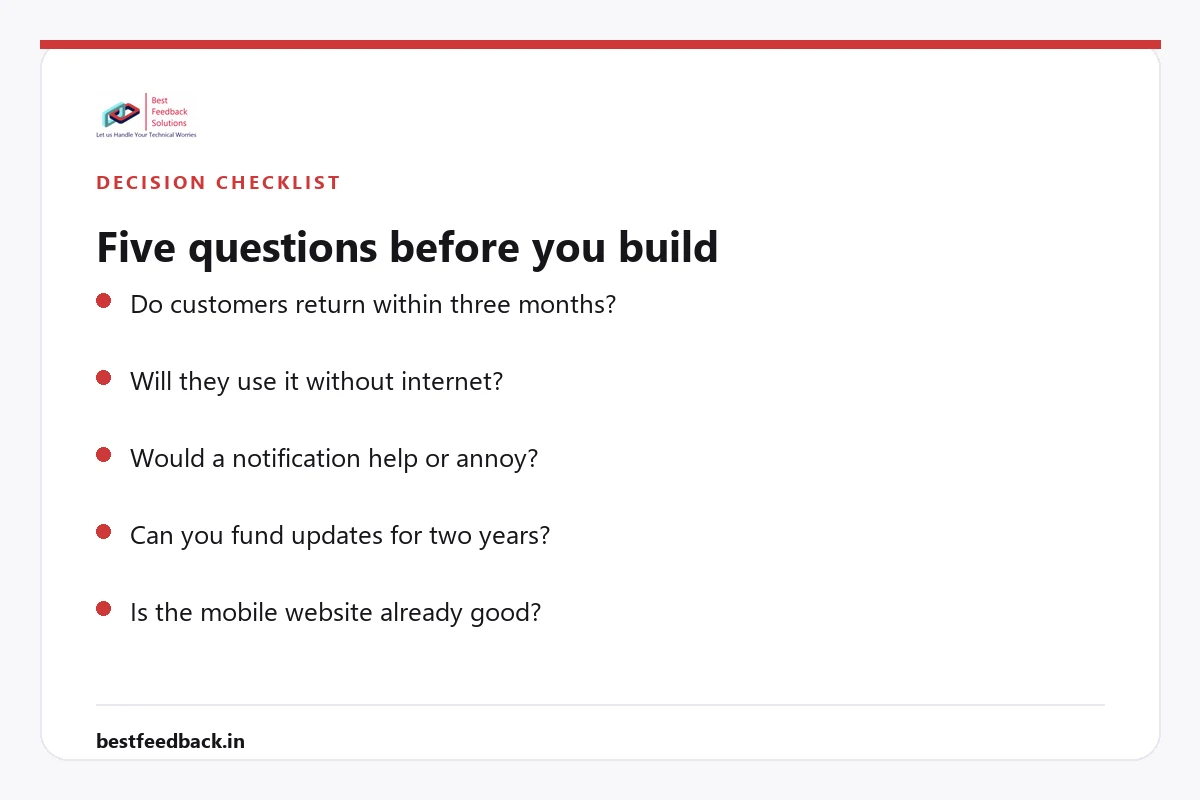
- Do at least a third of my customers come back within three months?
- Would they use the app somewhere with no internet?
- Would a notification help them, or annoy them into uninstalling?
- Can I fund updates for at least two years, not just the first build?
- Is my website already fast, complete and easy to contact from a phone?
Four or five honest yes answers point to an app. One or two point to a better website.
A sensible sequence for a Patiala business
Start with a responsive site that loads quickly and names your services and areas clearly. Add a complete Google Business Profile and real photos. Put WhatsApp and a call button where a thumb can reach them. Watch what customers actually do for a few months, then decide whether an app adds anything.
If you already know you need both, we build mobile apps for businesses and websites that work on a phone first. The order matters more than the technology: why businesses invest in mobile apps is worth reading before you commit a budget.
Do I need an app if I already have a website?
Only if your customers return often and the app does something the website cannot, such as offline access, reminders or saved history. For a first website, a fast mobile version will bring more customers than an app.
Which is cheaper to start?
A website is almost always cheaper to launch and to run, because there is one build, no store review and no second codebase to maintain. An app adds cost at every stage, not just at launch.
Can we start with a website and add an app later?
Yes, and that is the usual path. Build the site so the content and structure can be reused, then add an app when you can see repeat usage in your own enquiries and bookings.
Tell us how your customers buy and how often they come back. We will tell you honestly whether an app is worth it yet, or whether the website should come first.